
By Gloria Lloyd – Reporter, St. Louis Business Journal
A new hotel under construction in the St. Louis region is showcasing modular building techniques that allowed crews to erect the structure’s guest rooms in just over a week, marking a first for both the brand in Missouri and for commercial development in the city.
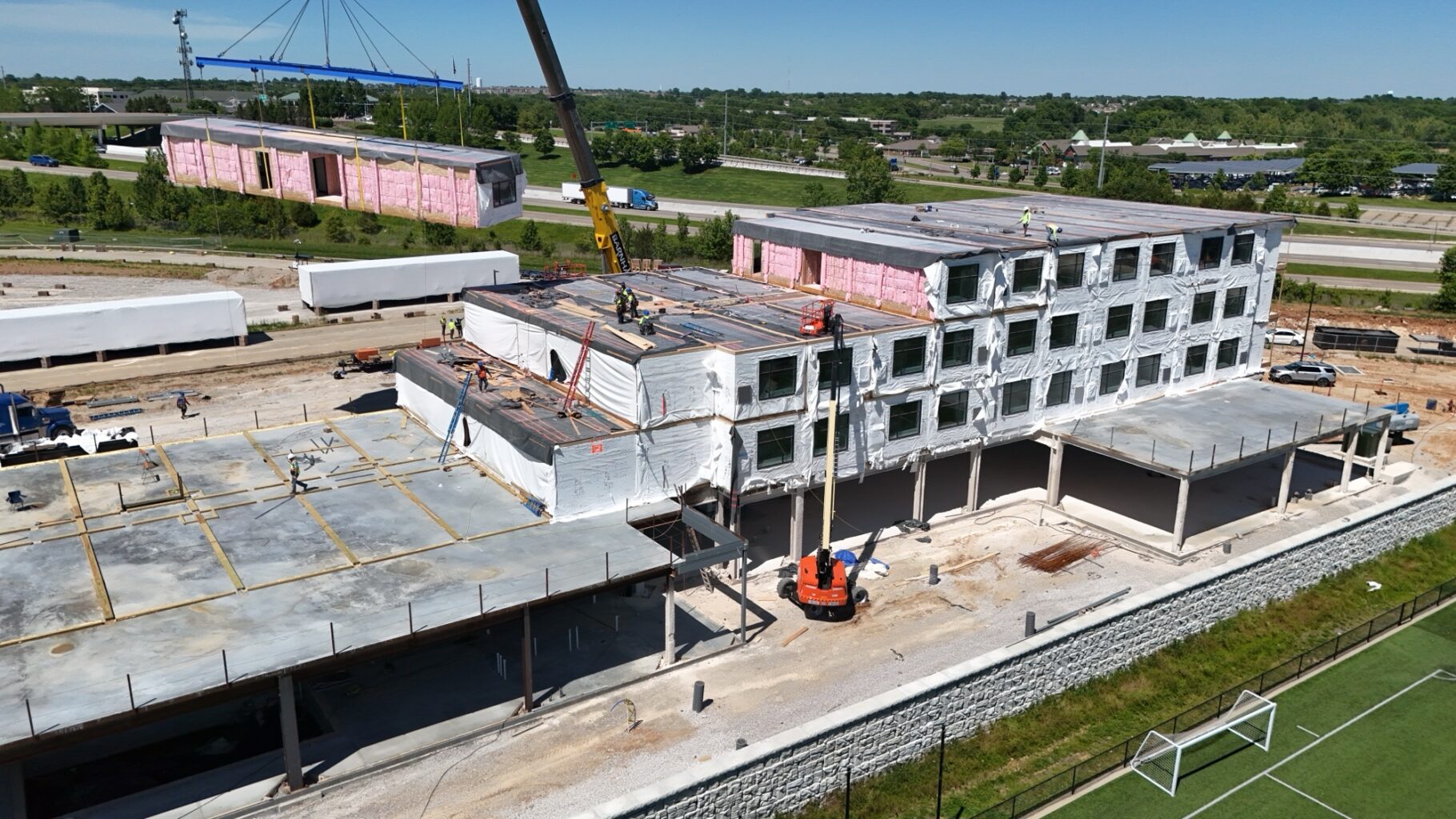
Crews in late May completed installation in eight days of 73 prefabricated modules that comprise all the guest rooms of the 112-room Cambria Hotel in O’Fallon, Missouri, taking the building from podium to four stories, project officials said.
The $30 million hotel, developed by Michigan-based Koucar Management and franchised under Choice Hotels International’s Cambria brand, is the first Cambria location in Missouri.
The hotel, at 220 Rush Way, is being built next to the Streets of Caledonia development near Interstate 64 and Route DD, on what was previously vacant farmland purchased in 2024 along with a neighboring site for roughly $2.5 million. The area was selected in part for demand from nearby corporate employers and sports tourism tied to adjacent soccer fields at Rush Park, project officials said.
The hotel is being financed by Bank of Old Monroe, which is based in Old Monroe and has a branch in O’Fallon, said the Cambria O’Fallon project manager Geo Babu of Koucar. The bank issued a $19.5 million mortgage on the property at the same time it was purchased in September 2024, according to data from real estate analytics platform Reonomy.
Unlike traditional hotel construction methods, the O’Fallon project relies on modular construction, in which guest rooms are built off-site and then transported and assembled on location. The modules were manufactured by Minnesota-based RISE Modular and shipped to St. Charles County for installation.
The hotel is expected to open by spring 2027, said Babu. Construction began in 2025.
Although a Cambria has been proposed in downtown Kansas City dating to at least 2019, that project has not moved forward, and the O’Fallon location will be Cambria’s first to open in the state.
The end result of using modular construction should be indistinguishable to hotel guests from other Cambrias built using typical wood-frame construction on site, Babu said.
“If you were to walk inside that room, compared to the first Cambria that we built here in Michigan, which was stick-built, you really can’t tell the difference between the two,” Babu said.
The modular approach significantly shortened the construction timeline, Babu said. A typical hotel takes 18 to 24 months to build. The modular process allowed guest rooms to be completed in RISE’s factory in three to four months and installed in eight days, well ahead of the scheduled three-week window. The guest rooms comprise three of the hotel’s four floors.
“Once they were finished and they arrived on site, the set time was eight days, and we were all blown away from that,” Babu said.
The modular approach also allowed construction to continue despite weather disruptions. While crews worked on the hotel’s concrete podium and site preparation in O’Fallon, RISE manufactured the guest rooms simultaneously in a climate-controlled facility, reducing delays from heavy rainfall that affected the region.
The modules, each containing two hotel rooms connected by a corridor, arrived nearly complete. Interiors that included flooring, fixtures, casework and furniture were installed in the modules before delivery, significantly reducing finishing work on site in O’Fallon.
“The only thing I have to do within these guest rooms is put linens on the mattresses … hang a TV, and put up window treatments,” Babu said.
The modular design is largely indistinguishable from traditional construction once complete, Babu said, though the rooms should be quieter than their traditional counterparts due to the double walls and floors created by stacking fully built units.
The first floor of the hotel is being built using traditional methods. That allows for larger entertainment spaces, Babu said. Those will include the developer’s own Italian restaurant concept, Verona, as well as a bar, patio and meeting space large enough to host corporate events and weddings.
While Koucar has used modular construction on other Cambria projects in Detroit and Maine, Babu said it remains uncommon across the brand, where most hotels are built using conventional wood-frame techniques. Modular construction fits the Cambria prototype well, said Troy Tiddens, vice president of design and project management at RISE.
The O’Fallon project is also notable as the first commercial modular construction project in the city, requiring coordination with local officials unfamiliar with the building method. Tiddens and the development team met with city inspectors early in the process to explain how the modules would be built, inspected and installed.
Babu and Tiddens said the project illustrates how modular construction could gain traction in the Midwest, where fewer manufacturers currently operate compared with coastal markets. Finding a modular partner capable of delivering a hospitality project in the central United States was initially a challenge, Babu said. Although RISE primarily worked on Midwest projects since it was founded in 2018, in recent years it’s expanded to work on projects in Wyoming and Colorado, Tiddens said.
RISE CEO Christian Lawrence said in a statement that projects like the Cambria demonstrate how off-site construction can deliver “speed, cost control and a high-end guest experience without compromising expectations.”
The project team also includes architect-of-record MGA Architects and Designers of Royal Oak, Michigan.
View the entire article at biz journals.com